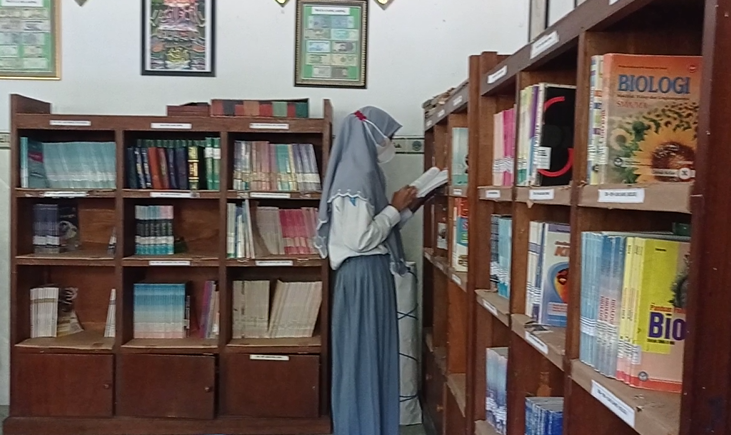
A. Yang bisa diterima sebagai anggota perpustakaan
1.Peserta didik Madrasah Aliyah Mamba’ul Ulum
2.Guru dan pegawai Madrasah Aliyah Mamba’ul Ulum
B. Syarat Keanggotaan
1.Anggota perpustakaan harus menyerahkan biodata lengkap dan pas foto 2 x 3 = 2 lembar
2.Anggota baru perpustakaan (kelas X) membayar kontribusi sebesar Rp 20.000,-/peserta didik
II. PEMINJAMAN
A. Pinjam Untuk Dibawa Pulang
1.Pinjam buku paket pelajaran
2.Pinjam buku referensi bacaan maksimal 2 buku
3.Lama waktu peminjaman maksimal 1 semester untuk buku pelajaran (boleh diperpanjang), dan untuk buku referensi 1 minggu boleh diperpanjang.
4.Semua buku boleh dipinjam, kecuali buku yang belum diberi label/stempel.
5.Setiap peminjam diharapkan memberikan sampul transparan apabila buku belum diberi sampul.
6.Setiap peminjam diharapkan menjaga buku dari kerusakan ( sobek, coretan, basah dan hilang)
B. Pinjam untuk dibaca di Perpustakaan
1.Saat diperpustakaan dilarang membaca keras, ramai dan berisik sehingga mengganggu pengunjung yang lain.
2.Setiap peserta didik yang selesai membaca buku harus mengembalikan ketempat semula dengan rapi.
3.Dilarang keras mengacak-acak buku yang tertata rapi
C. Pinjam untuk dibawa keruang kelas
1.Harus seizin petugas dan mengisi buku peminjaman sementara.
2.Harus bertanggung jawab penuh untuk mengembalikan buku ke perpustakaan sesuai dengan waktu yang ditentukan.
III. JAM/WAKTU PERPUSTAKAAN
A.Setiap hari mulai 07.00 WIB, tutup jam 12.30 WIB kecuali hari libur.
IV. SANKSI
A.Setiap buku yang rusak atau hilang harus mengganti dengan buku yang sama atau dengan uang seharga buku tersebut.
V. LAIN-LAIN
Bagi peserta didik, guru dan pegawai, MA. Mamba’ul Ulum Bedanten Bungah Gresik masuk perpustakaan, diharapkan mengisi daftar hadir yang sudah tersedia.
Dilarang membawa tas ke Ruang perpustakaan, kecuali kertas dan bolpoin.
Dilarang membawa makanan dan minuman di Ruang Perpustakaan
Dilarang membuang sampah atau mengotori ruang perpustakaan harap dikoordinir, sehingga ruang perpustakaan tetap tertib.
Bagi guru bidang studi/ guru piket yang membawa siswa-siswi ke Ruang perpustakaan harap dikoordinir, sehingga ruang perpustakaan tetap tertib.
Peraturan mengenai peminjaman buku ini berlaku untuk semua anggota.
Peserta didik harus di Madrasah pukul 06.45 WIB untuk melaksanakan sholat dhuha berjamaah dan mengaji bersama
Peserta didik yang terlambat harus melapor dahulu ke guru BK
Peserta didik yang tidak masuk Madrasah 6 hari berturut-turut tanpa keterangan dinyatakan keluar dari Madrasah
KEWAJIBAN PESERTA DIDIK
Mengikuti kegiatan proses belajar mengajar baik intra maupun ekstrakurukuler
Ikut bertanggungjawab atas kedisiplinan, kebersihan, keamanan, ketertiban, dan keindahan kelas, halaman serta taman.
Mengikuti upacara bendera/apel pembinaan
Membantu kelancaran pembelajaran baik di dalam maupun di luar Madrasah
Ikut menjaga nama baik Madrasah maupun keluarga besar Madrasah
Ikut bertanggungjawab dalam pemeliharaan fasilitas gedung, peralatan/perabot kelas, dan sarana penunjang pembelajaran Madrasah
Melengkapi diri dengan buku-buku pelajaran maupun alat tulis menulis
Membayar uang SPP (Syahriyah) dan sumbangan pendidikan lainnya yang telah disepakati melalui rapat komite
Taat dan patuh kepada pengurus, kepala madrasah, dewan guru, dan karyawan Madrasah Mamba’ul Ulum Bedanten
Memanfaatkan jam kosong (guru yang berhalangan hadir) dengan kegiatan positif yang dikontrol oleh guru BK/guru piket
Mengikuti kegiatan pembelajaran minimal 90% sebagai prasyarat PTS, PAS, UM, dan UAM-BN.
Berperilaku sopan dan santun pada guru, karyawan, dan sesama peserta didik
SERAGAM PESERTA DIDIK
Setiap Peserta didik wajib berpakaian seragam dengan ketentuan sebagai berikut:
Hari Sabtu dan Minggu : Pramuka lengkap dengan lencana yng melekat
Hari Senin dan Selasa : Baju putih dan rok/celana abu-abu
Hari Rabu dan Kamis : Baju batik dan rok/celana putih
Berpakaian olah raga waktu pelajaran pendidikan jasmani
Bersepatu hitam, kaos kaki putih (Hari sabtu, ahad, senin, dan selasa), kaos kaki hitam (Hari rabu dan kamis) dan berikat pinggang bagi laki-laki maupun perempuan
Berkopyah/songkok hitam (laki-laki)
Ber jilbab tanpa motif dan menutupi dada sesuai seragam yang ditentukan
HAK PESERTA DIDIK
Memanfaatkan dan menggunakan fasilitas Madrasah sesuai ketentuan yang berlaku
Alat dan bahan praktikum untuk mata pelajaran IPA
Media Pembelajaran;
Alat/perabot praktik untuk mata pelajaran Kesenian, Pendidikan jasmani olahraga dan kesehatan serta Keterampilan;
Komputer untuk praktek mata pelajaran TIK.
Menggunakan fasilitas perpustakaan/meminjam buku-buku perpustakaan
Mengikuti pembelajaran, praktikum, dan demonstrasi pada pelajaran Biologi, Fisika, Kimia, Bahasa, dan Komputer
Mengikuti kegiatan ekstrakurikuler sebagaiwadah pengembangan bakat minat dan keterampilan.
LARANGAN
Meninggalkan Madrasah pada saat jam kegiatan pelajaran tanpa seizin guru BK/ guru piket
Merokok, minum-minuman keras, berjudi, berpacaran, mencuri dan larangan-larangan agama baik di dalam maupun di luar Madrasah
Membawa alat komunikasi/audio visual (HP, radio) pribadi yang menganggu kegiatan belajar
Membawa dan membaca buku bacaan bergambar yang melanggar norma dan nilai agama
Memakai perhiasan dan berdandan berlebihan serta berpakaian yang tidak sesuai dengan ketentuan tata tertib
Peserta didik laki-laki berambut panjang, memakai anting, gelang dan aksesoris lain (tindik hidung, lidah dll)
Semua peserta didik berkuku panjang
Duduk dan bermain di meja guru
Berkelahi dan main hakim sendiri
Membuang sampah bukan pada tempatnya
Mengikuti perkumpulan/pergaualan/organisasi/geng terlarang
Melangsungkan pernikahan selama berstatus sebagai peserta didik dan belum dinyatakan lulus
SANKSI
Peringatan dengan lisan
Peringatan dengan pemanggilan orang tua
Diberi sanksi yang mendidik (sesuai kebijakan guru BK dan Kepala Madrasah)
Dikeluarkan dari Madrasah
LAIN-LAIN
Wali murid/orang tua yang akan menemui peserta didik harus melapor ke Kepala Madrasah/guru BK/guru piket
Peserta didik yang merusak/menghilangkan barang milik Madrasah harus mengganti
Hal-hal yang belum diatur dalam tata tertib ini akan ditentukan dikemudian hari.
Among organizations that experienced an AI-related breach, 97% lacked proper AI access controls, and 63% had no AI governance policy at all or were still developing one when the breach occurred. AI governance is the difference between scaling successfully and stalling out. In Australia, an automated debt recovery system—Robodebt—had human operators responsible for validating its outputs. Consequential AI decisions should remain subject to meaningful human review—especially in industries like healthcare, finance, and law, where small errors can have big consequences. Trustworthy AI systems should handle data privacy and personal data in compliance with applicable regulations.
The first step is conducting a comprehensive inventory of all AI systems, models, and automated decision tools across the organization. Below is a practical, enterprise-ready approach to structuring AI governance at scale. AI governance must also protect systems from misuse, cyber threats, and operational failure. Governing the full data lifecycle — from collection and preprocessing to storage and retention — is foundational to AI governance.
AI governance frameworks like NIST AI RMF address this by advocating for monitoring tools that support continuous assessment, rather than periodic reviews.
The transformative power of AI technology across countless disparate industries and use cases is still coming into focus.
By embedding governance directly into the AI lifecycle, Agentforce reduces friction between innovation and compliance.
The OECD defines explainability as “enabling people affected by the outcome of an AI system to understand how it was arrived at,” specifically so they can challenge that outcome and the factors that led to it.
This guide covers what AI governance is, why it’s non-negotiable, and how your organization can implement it at scale. This governance mapping project is intended to explore the potential capabilities and limitations of a scalable framework for analyzing how governance documents address AI risks. AI governance is an ongoing, iterative process that must evolve alongside AI technology, regulatory requirements, and organizational capabilities. There should also be robust feedback mechanisms that capture issues from users and impacted communities, and processes to update procedures that ensure governance keeps pace with technology evolution. This means governance frameworks must address how organizations verify accuracy for different use cases, what disclaimers are required, and when human review is necessary before acting on AI-generated content.
How can leaders get started with AI governance?
As AI systems become more sophisticated and integrated into critical aspects of society, the role of AI governance in guiding and shaping the trajectory of AI development and its societal impact becomes ever more crucial. The governance of AI involves establishing robust control structures containing policies, guidelines and frameworks to address various and specific challenges. This framework reflects the organization’s values and principles and aligns with relevant laws and regulations. It is the least intensive approach to governance based on the values and principles of the organization. With various considerations like data quality, model security, cost-value analysis, bias monitoring, individual accountability, continuous auditing and adaptability all depending on the organization’s domain, AI governance can never be a one-size-fits-all solution.
Explore the Governance Mapping Project
And when malicious code slips through, 60% of those affected rate the impact as “significant.” We welcome expressions of interest in engaging with our work – we will continue collecting user-stories to refine the tool. Please feel free to share feedback using this form – this will help us make the tool as useful and relevant as possible. Spot-checks are being used to provide feedback on misclassifications and to iterate the tool, improving its reliability.
However, while many artists find inspiration in these creative tools, many see them as threatening. At the enterprise level, the CEO and senior leadership are ultimately responsible for implementing AI governance throughout the AI lifecycle, typically delegating certain practical policy tasks to relevant stakeholders such as the CTO and their downstream. https://chinanews777.com/hotel-reports-from-usali-a-global-management-reporting-system.html Moreover, AI governance is not just about helping to ensure one-time compliance; it’s also about sustaining ethical standards over time. Understanding how AI systems make decisions to hold them accountable for their conclusions is an essential part of AI governance to help ensure that these types of programs make fair and ethical choices. By providing guidelines and frameworks, AI governance aims to balance technological innovation with safety, helping to ensure that AI systems do not violate human dignity or rights.
Who oversees responsible AI governance?
Ongoing fairness audits protect against discriminatory outcomes and reputational harm. Fairness governance requires proactive bias detection, mitigation strategies, and ongoing monitoring. AI systems must produce equitable outcomes across different user groups. With it, you create structured oversight across the entire AI lifecycle. A strong AI governance framework isn’t a single policy but coordinated pillars that work together.
AI governance frameworks direct AI research, development and application to help ensure safety, fairness and respect for human rights.
Governance tools should also integrate directly into the AI development lifecycle — often through AIOps or MLOps pipelines.
AI governance is the discipline of embedding accountability, aligning funding to strategic posture, and tracking what AI operations cost so an enterprise can deploy AI safely and at speed.
This includes data quality assessment capabilities, algorithmic evaluation skills, and familiarity with model monitoring approaches.
AI regulation updates, enforcement actions, and research
For enterprise-level businesses, any AI governance solution should enable broad oversight and control over AI systems. The https://elitecolumbia.com/hotel-reports-from-usali-a-global-management-reporting-system.html automation capabilities of AI can significantly enhance efficiency, decision-making and innovation, but they also introduce challenges related to accountability, transparency and ethical considerations. The concept of AI governance becomes increasingly vital as automation, driven by AI, becomes prevalent in sectors ranging from healthcare and finance to transportation and public services.
You have a small advantage if you have a relevant background, such as experience at a power or infrastructure company or in the public sector, but it won’t make a night-and-day difference. This publication contains general information only, and none of Deloitte Touche Tohmatsu Limited, its member firms, or its and their affiliates are, by means of this publication, rendering accounting, business, financial, investment, legal, tax, or other professional advice or services. Yes, you have an advantage if you aim for something highly relevant, such as an infrastructure private equity firm or corporate development at a power company, but you’re not precluded from more generalist opportunities. Some of these focus on larger corporate-level deals (GS), others are stronger in conventional energy (Barclays), and others are stronger in renewables (BAML). Also, since rising fuel prices represent a major risk factor for both, an electric company that relies on natural gas might be able to hedge some of the risk by acquiring a gas utility and selling gas when prices rise.
In the United Kingdom and Ireland, the state, private firms, and charities ran the traditional public utilities. With over 90 million customers, it https://scivast.com/articles/understanding-mcl-water-testing-importance-impact/ is one of the world’s largest electricity companies. Perusahaan Listrik Negara (PLN) is the national electricity company of Indonesia. Should rates rise, the company must offer higher yields to attract bond investors, driving up the utility’s interest expenses.
The transmission lines used in the transportation of electricity, or natural gas pipelines, have natural monopoly characteristics. Public utilities are meant to supply goods and services that are considered essential; water, gas, electricity, telephone, waste disposal, and other communication systems represent much of the public utility market. Utilities (water, electricity and gas) are essential services that play a vital role in economic and social development. Electric companies are expected to make massive investments to modernize the grid to address growing electricity demand. The AI age is expected to require scaling data centers, grid capacity, and supply chains. Please see /about to learn more about our global network of member https://www.montsec.info/practical-and-helpful-tips-15/ firms.
United Kingdom and Ireland
Before making any decision or taking any action that may affect your finances or your business, you should consult a qualified professional adviser.
Resource adequacy rules are expected to start recognizing flexible load paired with four-hour batteries as a dependable capacity resource.
Some, especially large companies, offer multiple products, such as electricity and natural gas.
The US Department of Energy projects about 104 GW of coal and natural gas retirements by 2030, offset by 209 GW of new capacity.11 Yet only 10% of those additions will be firm baseload, widening the reliability gap (figure 1).12
For example, let’s say the company’s Rate Base is $1,000, as in the Lazard example above.
Utilities are expected to integrate multi-year, multi-vendor supply agreements, embed grid-enhancing technologies, and use digital tools to track supplier and inventory risks in real time. Over the past few years, lead times for critical grid equipment such as transformers and switchgear have stretched to multiple years (figure 3), while equipment and project costs continue to rise. Additionally, utilities are exploring federated learning techniques to improve models across sites while keeping data local, offering a secure path to expand system intelligence.36 Together, this infrastructure can help balance resilience, compliance, and scalability for enterprise adoption. Power companies are building computing infrastructure that blends edge, cloud, and on-premises capabilities (figure 2).35 Edge AI—from drones to substation sensors—enables millisecond-level decisions.
About MVU
For example, let’s say the company’s Rate Base is $1,000, as in the Lazard example above. The ideal “base load” fuel sources include those with high fixed costs and low variable costs, such as coal, nuclear, and hydroelectric power. These load metrics https://bussinessfair.info/navigating-the-path-to-sustainability-challenges-of-green-economy.html matter because companies tend to use different fuel sources to meet each type of demand.